Nearly 70% of pregnant women take at least one medication during pregnancy, yet fewer than 1% of clinical trials include pregnant or breastfeeding participants.[1] This leaves an entire population without reliable evidence to guide their care decisions.
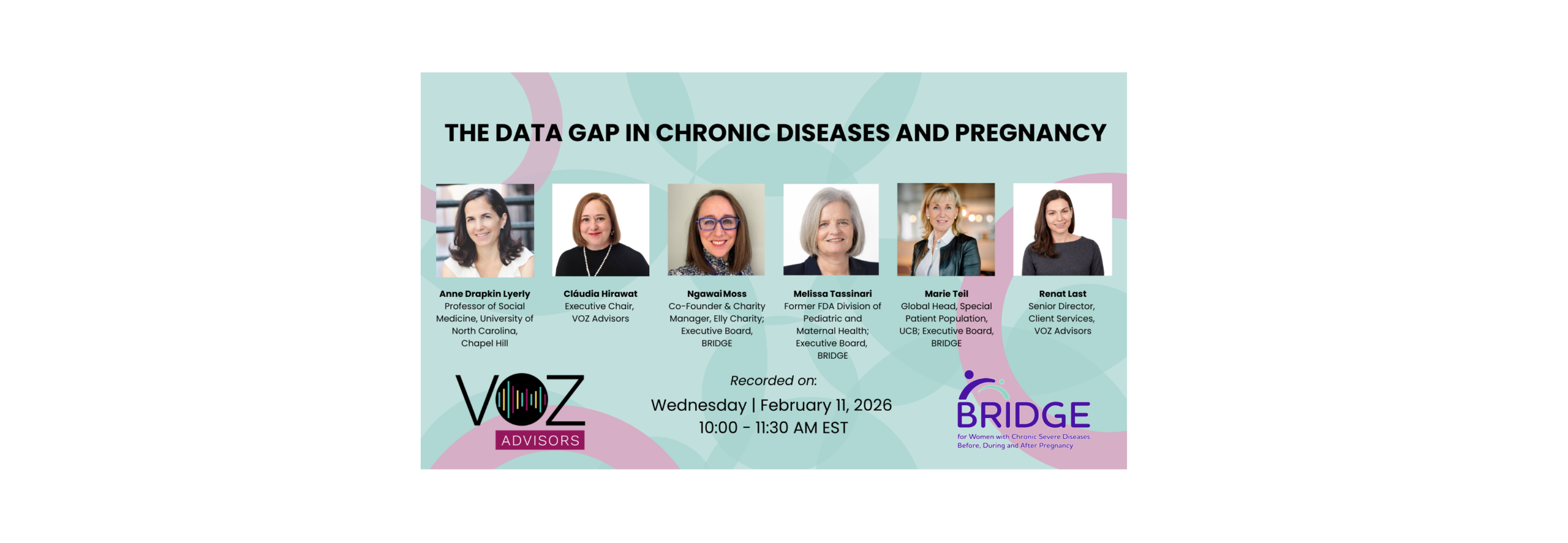
VOZ hosted a recent webinar in partnership with BRIDGE, bringing together maternal health advocates and experts to examine long-standing assumptions, ethical considerations, and the role of collaboration in driving change to ensure healthier pregnancies and better long-term outcomes, specifically for women with chronic diseases.
Webinar Moderator and VOZ Senior Director, Renat Last, shared her key learnings and reflections from the discussion:
- Exclusion does not equal ethical protection: Excluding pregnant and breastfeeding people from clinical trials is often framed as protective. But in reality, as emphasized by Anne Drapkin Lyerly, UNC Chapel Hill, the absence of data forces patients and providers to make high-stakes decisions without evidence, often leading to inaction and poorer maternal outcomes.
- The real barrier is access, not willingness: The long-standing narrative that pregnant and breastfeeding women are unwilling or afraid to participate is inaccurate. Women living with chronic conditions consistently express a desire to engage in research — not out of obligation, but out of purpose, community, advocacy, and a commitment to improving care for future generations. As Bridge Co-Chair, Ngawai Moss highlighted, the key issue is a lack of opportunity, access, and intentional inclusion in research design.
- Treatment options have not advanced: VOZ Advisors Executive Chair, Cláudia Hirawat shared that decades after navigating a pregnancy with a chronic condition herself, treatment options have barely evolved, underscoring the need for both inclusion and longitudinal research.
- Need for longitudinal research for greater public health impact: Bridge Co-Chair, Ngawai Moss commented on how meaningful inclusion must go beyond pregnancy alone, incorporating long-term, longitudinal studies that evaluate outcomes for both mothers and children. This research will not only improve individual clinical care and decision-making but also improve public health by impacting families and future generations.
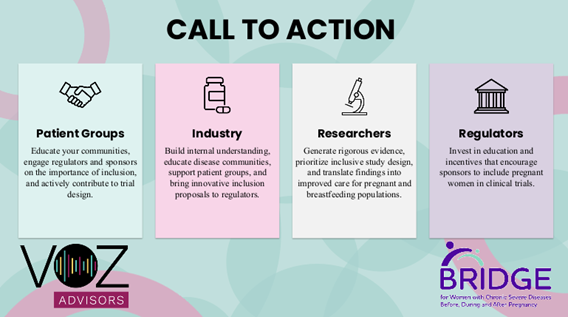
- Collaborative efforts will drive change: Both BRIDGE Co-Chair, Melissa Tassinari, and Marie Teil, Global Head of UCB’s Women of Childbearing Age (WoCBA) Program stressed a call to action grounded in collaboration among researchers, regulators, industry, and advocacy groups to create meaningful, sustainable change. Melissa stressed the importance of patient advocacy organizations in educating communities about clinical research, addressing myths, and facilitating trial participation, as well as the importance of informed patient-provider dialogue to impact clinical outcomes. Marie emphasized that inclusive research must go hand-in-hand with strengthening trust across the care ecosystem.
When people with chronic diseases who are pregnant and breastfeeding are excluded from research, the resulting evidence base is fundamentally flawed, limiting the safety, efficacy, and relevance of care. Our webinar amplified that now is the time to move away from unvalidated, outdated assumptions and toward increased awareness and systemic change so that the experiences of those who may become pregnant or breastfeed are included in the data that shapes their care and well-being.
Our thanks go out to the panelists: Anne Drapkin Lyerly, Cláudia Hirawat, Ngawai Moss, Melissa Tassinari, and Marie Teil.
To view the full webinar and learn more about the panelists, click here.
[1] BRIDGE Report: Mitchell AA, Gilboa SM, Werler MM, et al. Medication use during pregnancy, with particular focus on prescription drugs: 1976-2008. Am J Obstet Gynecol. 2011.